The location of the church of the Holy Cross in Jerusalem (Santa Croce in Gerusalemme) was originally part of Saint Helena’s private palace, and founded by Helen in AD 320. Helena was emperor Constantine’s mother and while there is some doubt as to how devout the Emperor was when it came to Rome’s new religion, there is no doubt whatsoever about St. Helena’s dedication to her Christian faith.
The church, like San Giovanni in Laterano, is located right at the edge of the city limits, but it nevertheless became an extremely important site of pilgrimage. In the 16th century the urban architect pope, Sixtus V, had a straight road cut from Santa Maria Maggiore in the central-north part of the city that leads directly to the church of Santa Croce in the south-east.
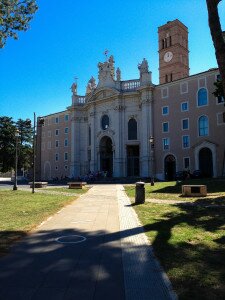
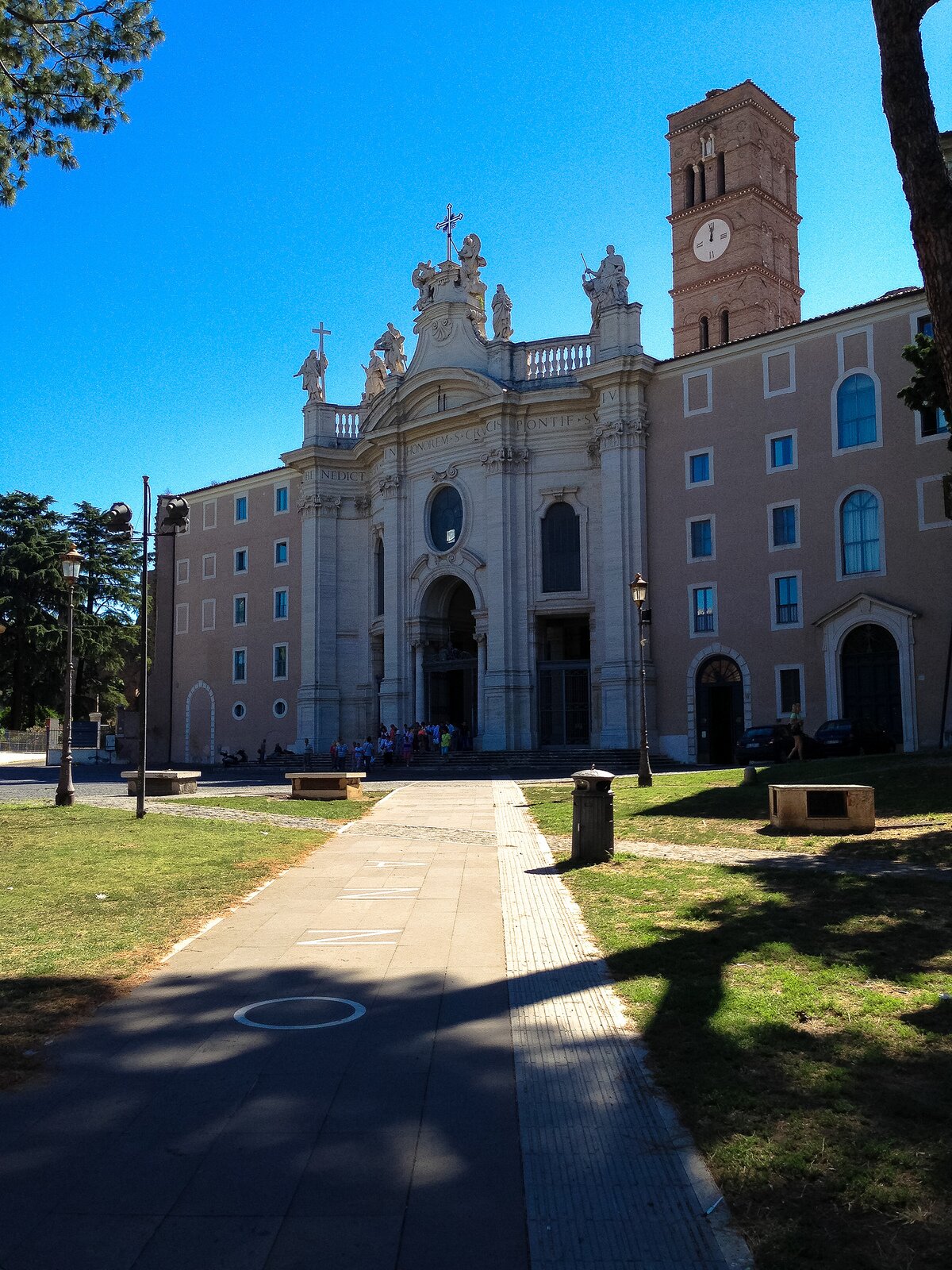
Facade, Santa Croce in Gerusalemme
During the Avignon papacy this area of Rome underwent serious depopulation and the church was abandoned. The area enclosed by the basilica of Santa Croce, the Lateran Basilica, and the old walls of Rome was used predominantly as farm land, or gardens with a number of hermitages dotted along the remains of the wall. Up until the 1870s the view from the Lateran would have been across open fields, vineyards, and flowering gardens to the white marble façade of Santa Croce, with access provided little more than a foot path to bring pilgrims to visit the basilica. That all changed when the area underwent a serious urban redevelopment plan in the early years of the Italian monarchy and the approach was finally transformed completed when the Via Carlo Felice was built in the late-19th century connecting the Piazza di Porta San Giovanni to Piazza di Santa Croce in Gerusalemme.
Saint Helena is believed to have gone to Jerusalem on pilgrimage in the 4th century and brought back a number of significant relics relating to the life of Jesus Christ. The church of Santa Croce was built to house the relics of the Crucifixion. Originally these were pieces of Christ’s Cross and one of the nails used during the Crucifixion, but today there are also other relics relating to the Crucifixion to be found in the Chapel of the Holy Relics, which dates from the 1930s.
The present church dates from the mid-18th century, commissioned by Pope Benedict XIV, the architects Domenico Gregorini and Pietro Passalacqua greatly modified both the interior and exterior of the church. However, these architects were not responsible for destroying the original 4th century basilica. The church had undergone restoration in the 8th century, under Pope Gregory II and was completely rebuilt in 1144 by Pope Lucius II, at which time a campanille or bell tower was added. In terms of the structure today almost nothing of St. Helen’s church remains, and the Romanesque bell tower is the only remnant of the mediaeval building.
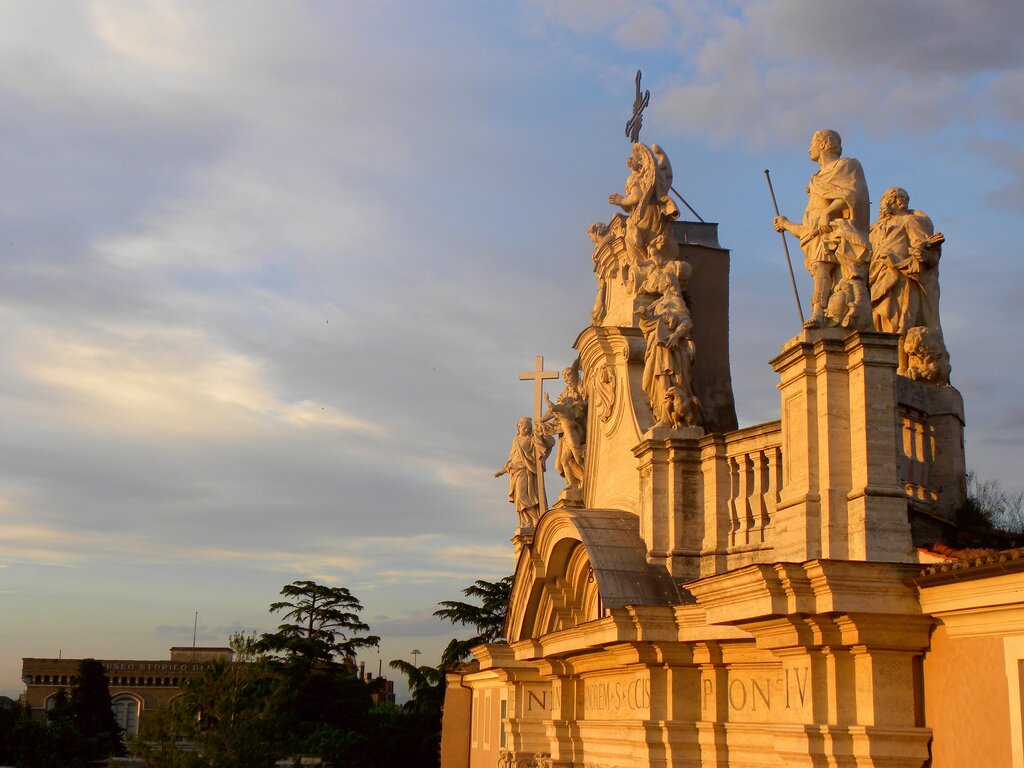
The 18th century façade is made of travertine in a late Roman Baroque style, taking inspiration from Borromini’s convex and concave designs for Sant’Agnese in Agone or San Carlino in Rome. Similar to San Giovanni in Laterano the whole building is topped with a line of giant statues, here depicting the four Evangelist’s, the emperor Constantine, St. Helen and angels. Once you step through the doors of the basilica you will find yourself in an elliptical atrium. The elliptical shape was very much in vogue in the 17th and 18th century, but the concept of an atrium or narthex before you enter the church proper is a typical architectural feature dating back to the early-Christian and mediaeval periods. The architects may also have been referencing some of the earlier examples of constantinian era church building, rather than using just the rectangular basilica style, here they opted for a centrally planned mausoleum style for the entry way.
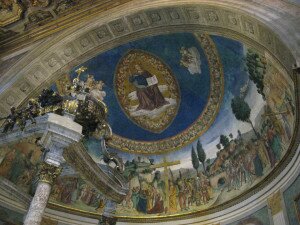
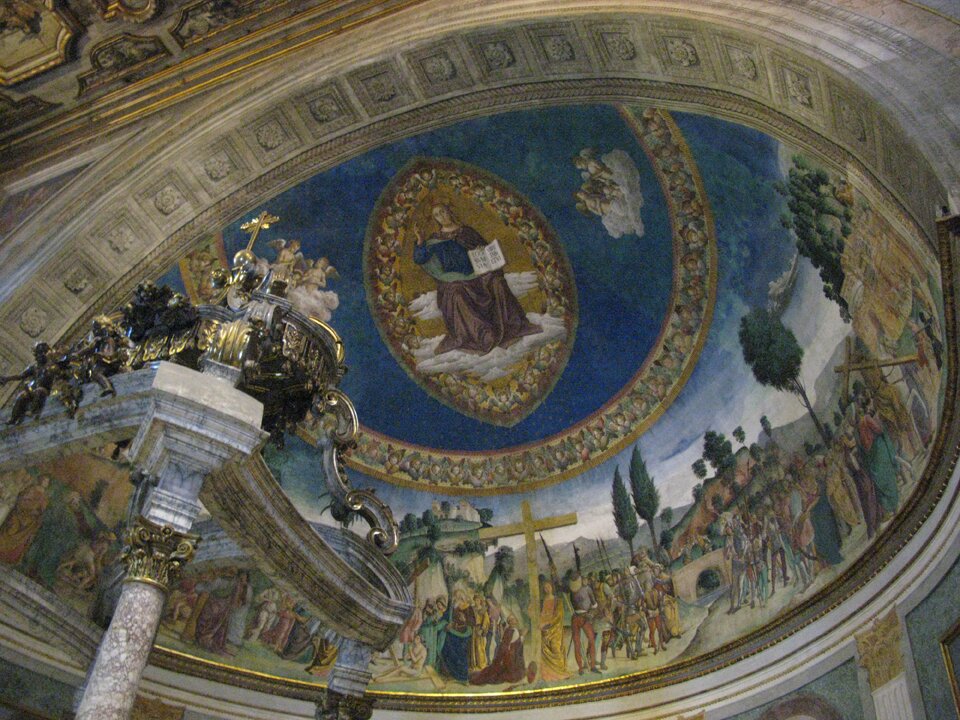
Apse decoration, Santa Croce in Gerusalemme
Passing through the atrium you come into the basilica itself: a perfectly formed rectangular, 3-aisled basilica terminating in an apse. Although most of the decoration and structure you can see today dates from the 15th -18th centuries, the layout is what you would expect to find in an early-Christian basilica. Luckily, not all the decorative elements were destroyed during the rebuild. The floor is a traditional cosmatesque design dating form the 12th century, but was restored in the early 20th century. The pink granite columns between the nave and side aisles are most likely those used in the original 4th century basilica and have been recycled and reused during the various interior renovations through the centuries. A small portion of the original Roman exterior wall brickwork has also survived and can be seen in the wall of the left-hand side aisle. Excavations, which include parts of the original ancient Roman palace structure, are open to the public at 11.00am on the 1st and 3rd Saturday each month.
The vaulted ceiling dates to the 18th century redesign of the interior. The second niche on the left of the nave contains an early-Renaissance carved wooden crucifix, attributed to the school of Donatello.
The apse frescos date from the late 15th century and depict the legends that surrounded the Cross in the mediaeval period. They are attributed to Melozzo da Forli, Antoniazzo Romano and Marco Palmezzano
Chapel of St. Helena
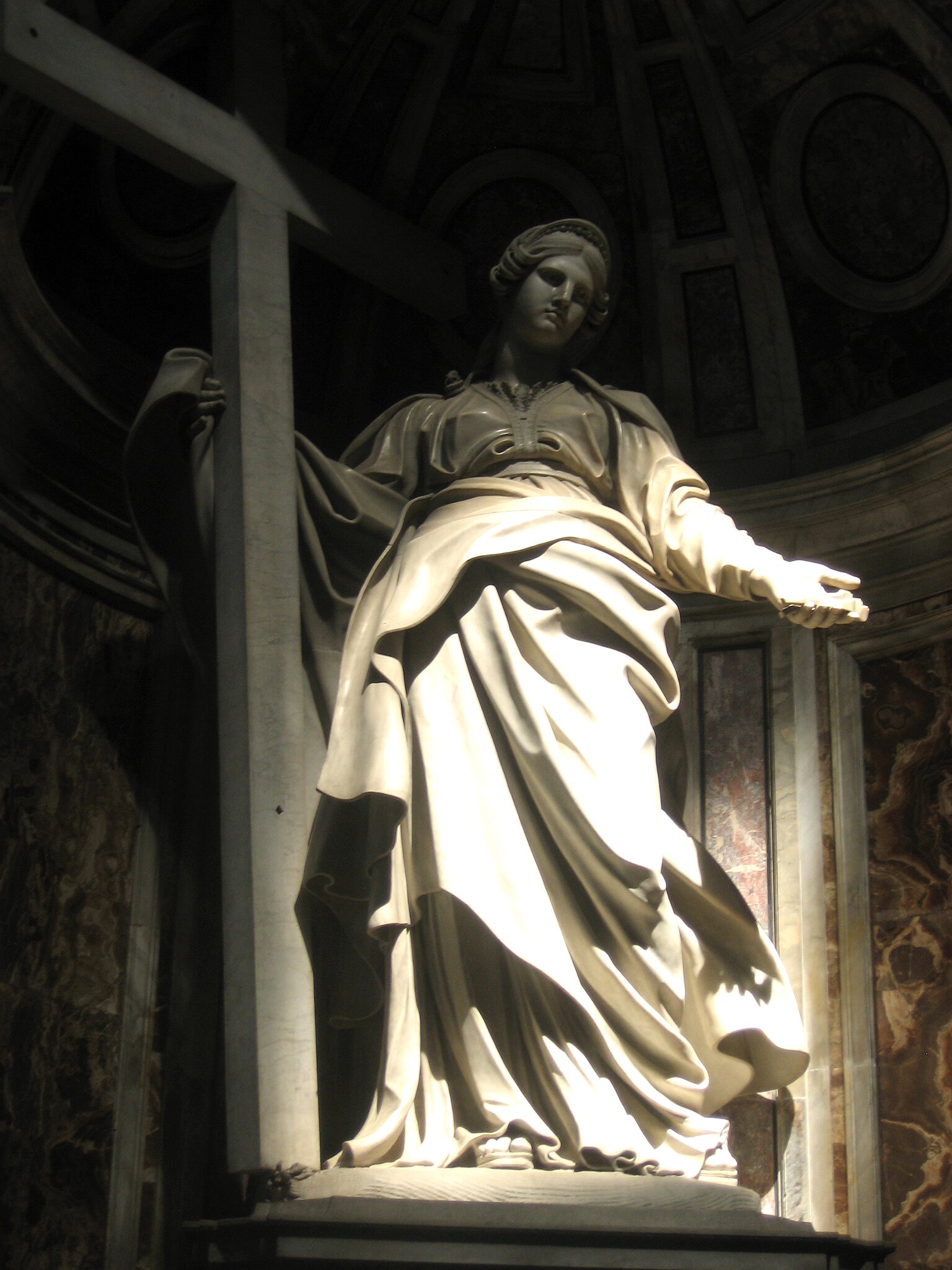
At the back of the church, to the right of the apse is a staircase leading down to the Chapel of St. Helen. The floor level here is nearly 2 meters lower than that of the church and is the actual floor level of the Sessorian Palace, where St. Helen lived in the 4th century. This suite of rooms was most likely converted by Helen to be her private chapel when she was alive and incorporated into the church when the basilica was built. St. Helen made a pilgrimage to the Holy Land and brought back many significant relics. One suggestion for this was that she wanted to give pilgrims who couldn’t afford to visit Jerusalem access to some relics in Rome. The chapel contains a statue of St. Helen which is actually a Roman antique statue of the goddess Juno with the arms and head removed and replaced with those meant to represent St. Helen and the Cross. The original ancient Roman statue of Juno, from which this was copied, can be found in the Vatican Museums. Beneath the statue you will see a glass covered area in the floor. The glass is there to protect a portion of soil believed to have been taken back from the Holy Land, which would mean pilgrims could kneel and pray at this chapel as if they were actually in Jerusalem. The name of the basilica Santa Croce in Gerusalemme means the “Holy Cross in Jerusalem”. Logically, this means it is dedicated to the Holy Cross, but the ‘in Jerusalem’ part comes from the fact that this church is considered to be, in part, actually in Jerusalem, due to the presence of this soil. The magnificent vaulted ceiling dates from the 16th century with mosaics made from designs by Peruzzi. Interestingly it contains a very rare example of a depiction of Jesus smiling in the center of the vault.
Beside the Chapel of St. Helen is the Gregorian Chapel, which was designed in the 16th century. At the altar of St. Gregory there is a silver-framed triptych, which is actually a reliquary containing over 200 relics. This altar became an important site of pilgrimage in itself from the 1530s, after the Council of Trent, due to the passing of the Decree on Purgatory. This decree was granted to certain altars, including this one, which would allow a plenary indulgence for the soul of the pilgrim along with the intersession, or help of St. Gregory when the Eurcharist was celebrated at the altar.
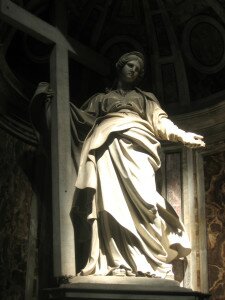
Statue of St. Helena at St.Peter's Basilica
The Chapel of Holy Relics:
There is an opening to the left of the apse leading to a staircase which goes up to the Chapel of the Holy Relics. Here you will find the most important relics, which are stored in the various reliquaries on display behind the altar area. The relics include the original fragments of the Cross and one of the nails from the Crucifixion, brought to Rome by Helen, but there are also a number of other items connected to the Passion, which were added at a later date. You will find fragments of the cross of the Good Thief, a joint from the finger of St. Thomas, and two thorns from the Crown worn by Jesus.
One of the most interesting relics in the Chapel was discovered by accident in the late 15th century. During restorations carried out by Cardinal Mendoza a brick with the inscription TITULUS CRUCIS was uncovered in the apse of the basilica. Behind the brick a box was discovered containing a wooden tablet on which was inscribed a fragment of the word Nazarene written in Hebrew, Greek and Latin. This Title was placed above at the top of the cross to indicate the reason for the death sentence. Originally it would have read: I. NAZARINVS RE [X IVDAEORVM] (Jesus of Nazareth King of the Jews).
It was believed to have been a mediaeval forgery as there had been no tradition of the veneration or existence of the Title, and certainly no mention of it having been taken by St Helen from Jerusalem along with the relics of the Cross. However, in the late 19th century a travelogue was discovered written by a Spanish pilgrim who visited the Holy Land in the late 4th century. In her writings, Egeria records the veneration of the TITULUS at a shrine in Jerusalem, which would seem to give contemporary confirmation of the existence of such a relic in the early Christian period. Although we have no record of how or precisely when it came to Rome, suggestions have been made as to why it was hidden behind the brick in the wall. In the 5th century Rome was under attach from the Visigoths and hiding important relics was common to protect them from the various sacks of Rome that took place.
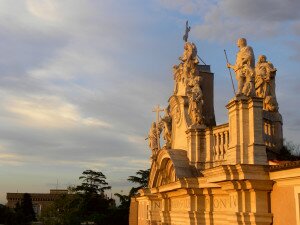
Pediment Statues on top of front facade, Satna Croce in Gerusalemme
To the right of the chapel in a separate area is an exact replica of the famous Shroud of Turin. This was added to compliment the other relics relating to the Crucifixion and death of Jesus and is a wonderful opportunity to inspect the Shroud for those who cannot travel to the north-Italian city. There is also a slightly disturbing statue of Jesus, based on the image on the Shroud.
One your way back down the stairs, before you return to the main church you will notice the fascinating shrine to Antonietta Meo, from the 1930s. Antonietta was a young girl who died, age 6, of bone cancer. Despite her young age the girl wrote letters, a prayer to Jesus dedicating her suffering to him, and is reported to have had visions. She is being considered for canonization as there is at least 1 healing which has been linked to her intersession since her death in 1937.
For more info and tours click on this LINK
Visit the parochial website for information on mass times and services: The church is open from 7:00 to 12:45, and from 15:30 to 19:30.
How to get there: Tram No. 3, from Ostiense station via Colosseo (east side). Bus 571, from Ospedale di Santo Sprito along the Corso Vittorio Emanuele, past Piazza Venezia and Colosseo (metro) and Bus 649; From Tiburtina and Termini train stations. You can also walk from San Giovanni Metro stop (metro A), it takes about 15 mins.
Content by Ciarán Durkan