The basilica of Saint Sebastian Outside the Walls (San Sebastiano fuori le Mura) is also known as Saint Sebastian at the Catacombs (ad catacumbas). It is one of the 7 Pilgrim churches of Rome and beneath the present church are catacombs that extending 3 levels underground.
As the name of the basilica indicates, it is located outside the walls of Rome, along the ancient Appian way. The first section of the Appian way dates back to 312 BC . In the 1st century AD, the site of the present basilica was actually below the level of the road. The Appian way was protected by retaining walls because there was a hallow which had deposits of pozzolana, a very important volcanic ash used by the ancient Romans to make mortar and cement. This was quarried, creating a deeper hole. The area was called catacumbas or ad cambas. Traditionally, this is said to be the Greek or Latin reference to the ‘hallow’ or ‘quarry’ on the site. However, according to the official history book of the catacombs at Saint Sebastian this is untrue; the word probably refers to a sign or image indicating the name of an inn, found in this area, depicting two or more little boats. Despite the uncertain meaning of the name, it is clear that it was at Saint Sebastian Outside the Walls that the word catacomb came into existence, and as a testament to the importance and fame of this particular catacomb, it is now used to describe various kinds of underground burial, not only Early-Christian sites, as for example the catacombs of Paris.
Saint Sebastian
Saint Sebastian was a late 3rd century martyr. The most popular account of his life and martyrdom comes to us from the Passio S. Sebastiani attributed to Pope Sixtus III in the 5th century, and there was probably more than a little imagination on the part of the author added to the real story. During the reign of Diocletian, Sebastian was a member of the Praetorian guard, the emperor’s personal body guards. He was denounced to the emperor because he had been heard preaching the Gospel and condemned to death by being shot with arrows. He was left for dead, but he was found by a woman named Irene. She nursed him back to health, and when he recovered he went back to the emperor only to be condemned to death for a second time by being beaten with clubs, and his body was dumped in great sewer of Rome. Then, he appeared to a lady called Lucina in a dream and told her where to find his body, and gave her instructions to bury his remains in the catacombs, near the remains of the Apostles. He is the patron saint of soldiers and athletes.
Originally, he was depicted as a fit but elderly man, but most people today will recognise him as a young, athletic figure, and in Renaissance and Baroque depictions of him, in painting and sculpture, he is generally portrayed as the embodiment of ideal male beauty.
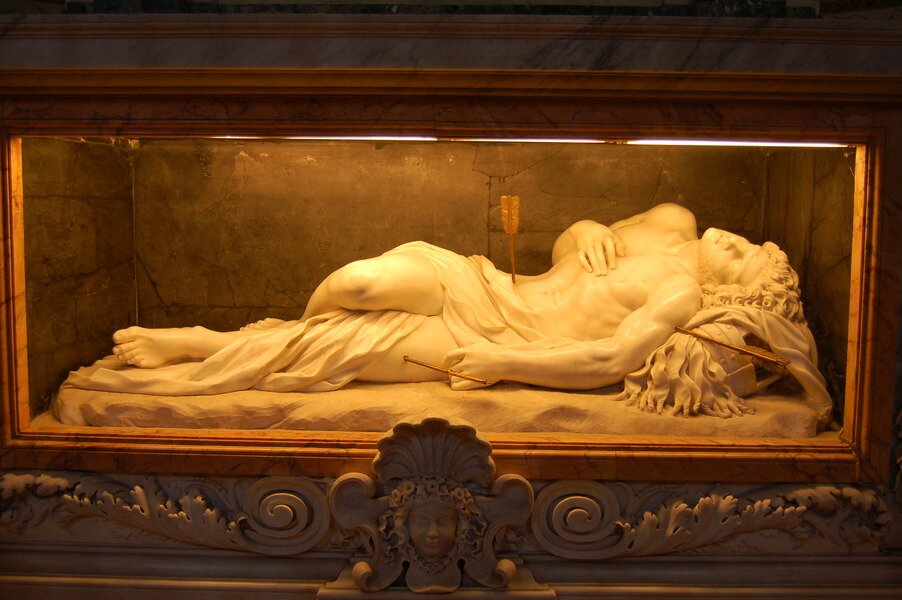
Marble statue of Saint Sebastian by Antonio Giorgetti. Photo by Flickr user: BestKevin
History of the Basilica of Saint Sebastian
During the emperor Valerian’s persecution of the Christians, in the mid 3rd century AD, the remains of the apostles St. Peter and St. Paul were said to have been moved to the catacombs for safekeeping. The first basilica was built in the 4th century, but was originally known as the Basilica Apostolorum (Basilica of the Apostles) because of its role in keeping the relics of the apostles safe during this period. In the 4th century, after Constantine made Christianity legal and built the St. Peter’s Basilica and St. Paul’s Basilica, the remains of the respective saints were transferred to these new churches. The body of Saint Sebastian was moved to the catacombs in 350 AD but was later moved to St. Peter’s basilica for fear of a Saracen attack, which actually happened in 826 AD, resulting in the original basilica on the site being destroyed. Later, in the mid-9th century, Pope Nicholas I rebuilt the church and it was dedicated to St. Sebastian. The martyr’s altar was reconstructed in the 13th century by Pope Honorius III. The basilica today is mainly a 17th century rebuild commissioned by Cardinal Scipione Borghese in 1609. (The Cardinal was the nephew of Pope Paul V, who was responsible for the completing the façade of St. Peter’s Basilica and whose name appears on the front of the building.)
The Basilica of St. Sebastian: a tour of the interior.
The design of the interior of the basilica is very much in keeping with the style of early 17th century architecture. It is, however, nowhere near as impressive or highly decorated as one might expect from a Baroque church interior. It has a single interior space, the open nave. The side aisles, which were originally part of the earlier basilica, were not made part of the 17th century design. In the 19th and early 20th century they were excavated, revealing part of the earlier structures on the site, and are now used as entry and exit coridoors for the catacomb tours. Instead of aisles, the interior has chapels set into deep arched recesses in the sidewalls. There is none of the polychrome marble or gilding one would expect from a Baroque redesign, instead the walls are covered in plaster and painted a muted cream colour. The most decorative feature about the church is the carved wooden ceiling, which dates from 1613. The flat, coffered ceiling has been designed in panels, which have been painted and gilded. The central panel contains a large relief carving in wood, painted in a naturalistic way, of the martyrdom of St. Sebastian by Annibale Durante.
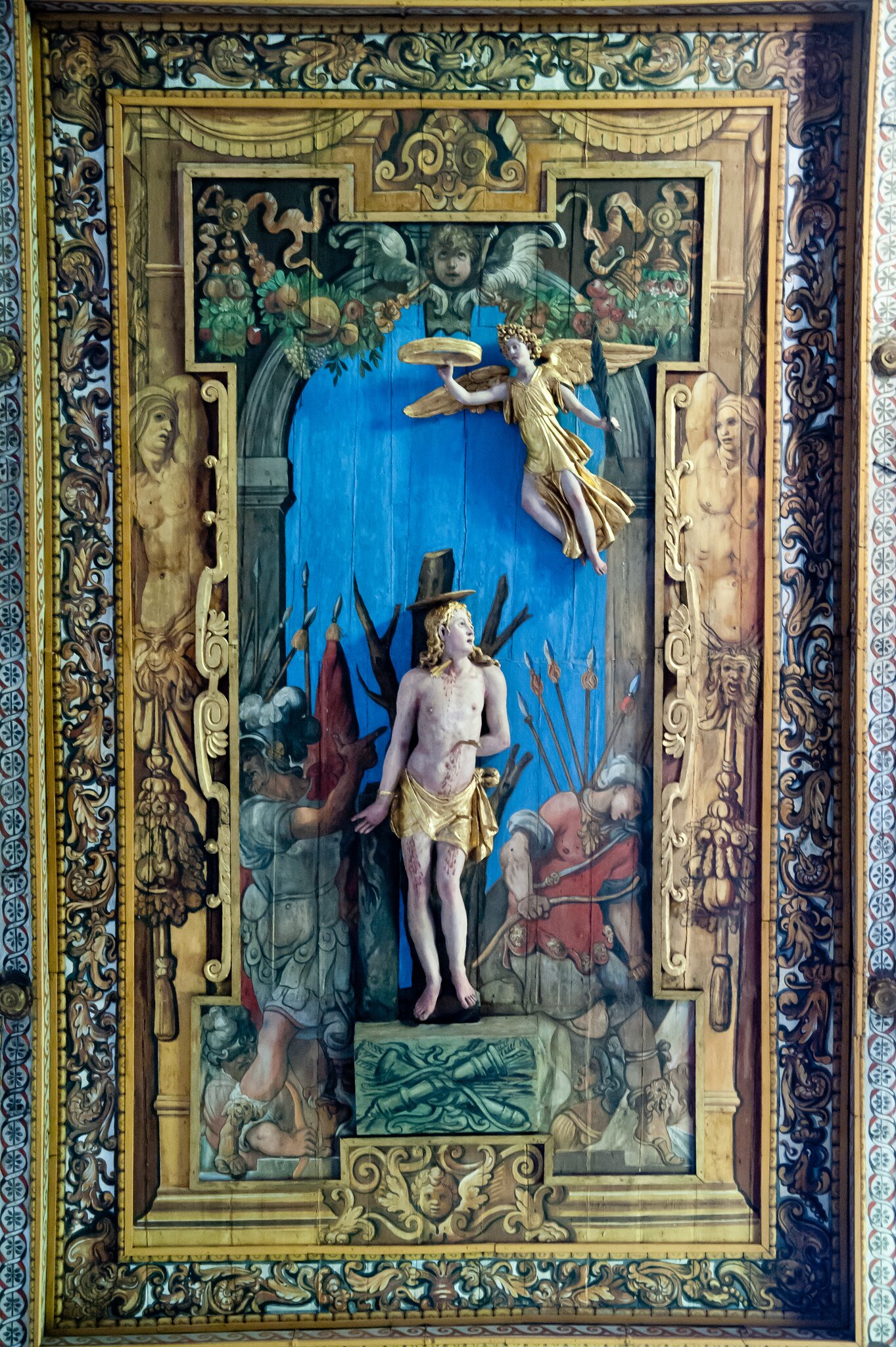
Ceiling panel in relief depicting the martyrdom of Saint Sebastian by Annibale Durante. Photo by Flickr user: Chris Williamson.
The first niche on the right, as you enter the church, contains a marble bust on a pedestal. This is a representation of Jesus as Salvator Mundi (The Saviour of the World). The magnificent, voluminous drapery gives the impression of movement and drama and immediately reminds the viewer of the genius of Gian Lorenzo Bernini, one of the most prolific artists of the 17th century. It was, in fact, only ‘rediscovered’ and attributed to Bernini in 2001. Completed in 1679, when Bernini was 80 years old, it is the last work of art from the hand of this great sculptor.
There are 6 side chapels, the two most important being the Chapel of St. Sebastian and the Chapel of the Relics, located in the first arched recess on the left and right of the nave, respectively.
The Chapel of St. Sebastian was designed in 1672 and contains the shrine of the saint. There is a famous marble statue of St. Sebastian, lying down and about to die, by Antonio Giorgetti, a student of Bernini. The statue is encased in a marble and glass box, above which the altar is positioned. The inscription on the altar reads “St. Sebastian, expeller of bubonic plague”. St. Sebastian was considered a protector of the plague, and during the outbreaks of several types of plague and disease the people of Rome would come to the basilica of St. Sebastian here, or the one at the Palatine in the city, or to an altar dedicated to St. Sebastian in one of the other churches to pray for salvation and protection. One theory for the use of whitewashed, plaster walls (rather than marble) is that the pilgrims who visited these ‘plague’ churches would touch the walls, statues, or inscriptions so that they might have a physical connection with the saint, relic, or venerated image or statue that was said to have powers of healing or protection. In so doing, those already infected were spreading the disease by leaving traces of it on the walls, which could multiply on the marble or stone surface, and then be picked up by the next person who touched it. This is certainly true of the then newly built church of Santa Maria in Campitelli in Rome, housing the venerated icon the Madonna of the portico after the plague of 1656 that devastated Rome, where the interior was whitewashed with calce viva used to sanitize infected houses. The post-plague interest in the Basilica of San Sebastian, the redecoration of the Chapel of St. Sebastian, dates from after the plague and may have been due in part to the fullfilling of a vow to build a church, or a monument if the person was safely delivered from the outbreak. This happened in Venice, during an earlier outbreak, which resulted in the building of the Church of St. Sebastian and the famous Il Redentore by Palladio earlier in the 17th century.
The Chapel of the Relics houses a large number of the relics, including: a thorn from the Crown of Thorns; a finger, tooth and part of the rib of St. Peter; a tooth belonging to St. Paul; the arm of St. Andrew; part of the head and the arm of St. Fabian; the head of Pope St. Callixtus (the catacombs of St. Callixtus are just across the road from St. Sebastian and are the largest in Rome); the head of Pope St. Steven; the arm of St. Roch. There are also relics specifically related to the martyrdom of St. Sebastian: an arrow and part of the column to which he was tied. There is also a piece of basalt stone, which is identical to those used to pave the ancient Roman Appian way, with the indentation of footprints, said to have been left by Jesus during the “Domine Quo Vadis?” story as indicated in the apocryphal Acts of Peter. The church of Domine Quo Vadis is a few 100 metres away from the Basilica of St. Sebastian on the Via Appia Antica, but the relic was moved here in the 16th century because the church had been abandoned and was in ruins. (Click HERE for more info on the Domine Quo Vadis story)
The Catacombs of Saint Sebastian
Today, the catacombs beneath the basilica are open to the public and accessible through a side door to the right of the entrance portico. Tickets cost ?? and tours are run in every major language. Access is granted only as part of an organised group, lead by one of the resident guides, but tours are run regularly and the wait is rarely more than 30 minutes. During that time you can visit the basilica, or take a look at the gift shop, which is to the left of the entrance portico. Both of these side aisles contain fragments of inscriptions, and sarcophagi, which were found during the excavations of the catacombs, which began in the late 19th century and continued until the 1960s.
It was common in Ancient Rome to bury the dead outside the city limits, the word necropolis, the term used by the Romans to describe their cemeteries, means “city of the dead”, and it was part of Roman law that burials should not take place in the “city of the living”. There are at least 60 underground burial chambers dotted around the outskirts of Rome, many of them along the Appian way, or other major roads leading to Rome. In ancient Rome the custom was to cremate bodies, and place their ashes in an urn, which would be stored in a mausoleum or tomb. This custom was not universal, however, and by the 2nd century AD the Jews and Early Christians began to bury the bodies of their loved ones in sarcophogi or in the ground. Due to the restrictions of land, space, and money more and more of these burials were taking place in underground cemeteries. The soil around Rome in many areas is a soft volcanic clay called Tufa, which was easy to excavate and burial in this way was standard practice, particularly for Christians until the 4th century, when Christianity was made legal. It remained popular, as believers wished to be buried close to important saints, and martyrs, but burial gradually became more fashionable in church cemeteries. In the 6th and 7th centuries the catacombs were mainly used for memorial services on the feast days of the martyrs associated with them. The attacks on Rome by the Ostrogoths, Vandals and Lombards meant that many of the remains were transferred to churches or cemeteries inside the protection of the city walls and certainly by the 10th century the catacombs were all but abandoned and in time forgotten. They were rediscovered, accidentally, in the late 16th century and Antonio Bosio published the first book on the subject in 1632. They were not seriously investigated and excavated until the 19th century.
It is a commonly held belief that early Christians chose to bury their dead in underground catacombs so that they could hide from persecution, but this is a myth. They were simply following the laws and customs of the time, and making use of the fact that the tufa was easy to carve. It is naïve to think that the Roman authorities didn’t know that hundreds of thousands of burials were taking place a few miles outside the city. The tufa was probably excavated by slaves, who created a series of galleries and tunnels, which over time grew into a multi-leveled complex. The bodies were buried in loculi or chambers carved out of the walls of the galleries, which were then sealed with a marble or brick slab inscribed with the name of the person and the day of their death.
The catacombs at St. Sebastian are quite small, but burial began here in the 1st century AD, making them one of the oldest in Rome. The first burials were in and around the walls of the hallow and tunnels of the pozzolana quarry. This cemetery was demolished and the vaults of the quarry were destroyed in the 2nd century and the whole area was back filled, which raised the floor level by 3 metres, and created a kind of "piazza". Around this three mausoleums were built, with underground chambers and many loculi tombs carved into the sidewalls of the hallow. The mausoleums were probably not originally built for Christian burial but there is a suggestion that they were later used for this purpose due to the presence of early-Christian symbolism found painted in the frescoes and symbols carved into the loculi coverings. To the west of this cemetery, accessed by a lane leading up and out of the hallow there was a number of buildings. The remains of a luxurious villa were found with mosaic floors and walls covered in decorative frescoes. 2 more rooms were also found, probably shops and a second house, not as luxuriously decorated as the larger villa. The second, smaller house may have been connected with the cemetery itself.

Mausoleum with decorated plaster ceiling at the catacombs of Saint Sebastian. Photo by Flickr user: Patrick Denker
In the mid-3rd century AD the small cemetery was abandoned and filled in to create the foundation for another structure, the triclia. This consisted of a portico facing a coutryard, which was on a lower level accessed by a flight of stairs. The east side of the portico, along the back wall, had a bench in masonry. This was mostly used as a funerary area, a gathering space where the deceased could be commemorated and a small meal could be taken in their memory. Here, a lot of graffiti was found carved in an around the masonry bench, talking about the Apostles Peter and Paul, with people indicating they took part in the commemorative ceremony in their honour. There is still ongoing debate as to whether or not the remains of Saints Peter and Paul were ever actually moved here, but it is clear from the graffiti that this site was associated with some relic connected with the apostles.
Most of the burials date from the 3rd and 4th centuries and it is certain that the catacombs were in use during the time of persecution of the Christians when St. Sebastian was martyred. Today, if you take a tour of the catacombs, you will be taken down to the third level, about 12 metres below the present day basilica. You can still see the crypt and altar of St. Sebastian, and will have the opportunity to walk along the maze of galleries past hundreds of empty loculi. The ‘piazza’ with it’s three mausoleums has been excavated down to the original floor level and you can still see the decorative plaster work and fragments of brightly covered fresco dating back 1,800 years. Part of the triclia, including the graffiti covered seating area, have also been excavated creating an enormous underground cavern with the foundation of the older basilica visible directly overhead.
The Basilica is open 8am – 1pm and 2pm- 5.30pm. For more information on the basilica click HERE.
The tour office for the catacombs is open Monday to Saturday, 10am - 4.30pm, click HERE to access the website.
How to get there
Buses 118 (Coloseo metro stop), 218 (San Giovanni metro stop) and 660 (Colli Albani metro stop) leave from the city centre. The bus stops right across the road from the entrance to the Basilica of St. Sebastian, however, you will need to walk up the road for a few hundred metres to the car park of the Catacombs of San Calisto to catch the bus back to Rome.
Visiting the surrounding Park of Appia Antica
Alternatively, take one of the bus tours which includes a visit to some of the other sites in the area, or walk or cycle through the Parco Caffarella (Archeological Park of Appia Antica) and see some of the ruins of ancient Rome on your way there. You can rent bikes at the Park information office, located on via Appia Antica, 58. Click on this LINK for more info.
Not far the Basilica of St. Sebastian is a part of the Ancient Appian way, which is still paved with its original basalt paving slabs, and open to the public free of charge. The large, circular tomb of Caeclia Metella is located on one side of the road, and the ruins of a gothic building on the other. A mile down the road is the church of Domine quo vadis?


